
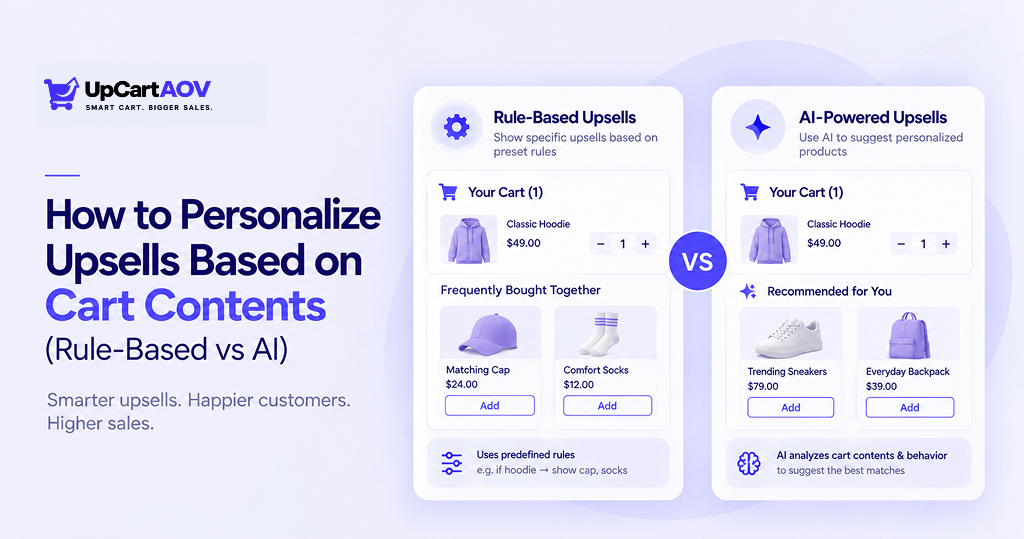
Jenna Cooper runs Marlowe & Wren, a skincare brand out of Austin, Texas. Her ads were converting fine, but her average order value hadn’t moved in almost a year. People added one product, checked out, and left.
The fix wasn’t a bigger ad budget. It was learning how to personalize upsells based on cart contents, reacting to what’s already in the cart instead of showing the same generic recommendation to everyone.
That raises one real question every founder eventually hits: should that reaction run on simple logic you control, or on an algorithm?
That’s the rule-based vs AI upsell recommendations debate, and this guide breaks it down in simple terms.
Why this matters if you’re running the store:
- A 5–10% lift in average order value often costs nothing extra in ad spend
- Cart-level personalization is one of the few levers you can pull without waiting on a developer
- It works whether you’re a solo founder or running a growing team
What Is Cart-Content-Based Upsell Personalization?
Picture two shoppers walking up to a checkout counter at Marlowe & Wren at the same time:
- Shopper one is holding a bottle of Vitamin C Serum.
- Shopper two is holding a bottle of Body Lotion.
A good in-store employee wouldn’t say the same thing to both of them:
- To shopper one → they’d point at the matching Moisturizer + SPF
- To shopper two → they’d mention the Body Wash that pairs with it
Nobody trained that employee with a spreadsheet. They just looked at what was in each person’s hands and reacted.
That’s the entire idea behind cart-based upsell personalization strategies, just moved online:
- Your Shopify cart drawer = that checkout counter
- What’s sitting inside it (right now, in this session) = the strongest clue you have about what to show next
Here’s what that looks like as a simple flow:
| Customer adds a product to cart | v Store “reads” what’s in the cart | v A relevant upsell appears (bundle, gift, shipping nudge, etc.) | v Customer adds more to reach it |
Why this matters:
- Most stores skip this loop entirely and show the same static recommendations to every visitor, serum shopper and lotion shopper alike
- The cart is one of the few places on your site where you already know exactly what someone wants to buy
- There’s no guessing involved; the data is sitting right there, waiting to be used
Fixing that gap is where rules and AI come in. Both are trying to answer the same question: “Given what’s in this cart, what should we show next?” They just get there in different ways.
Rule-Based vs AI Personalization
Rule-Based Personalization: How It Works
Rule-based personalization means you write the logic yourself: “If the cart contains Product A, show Product B.” No algorithm. No training data. Just a clear if-this-then-that setup.
Here’s the flow in picture form:
| Cart contains: Vitamin C Serum | v Rule: “If Serum is in cart” | v Show: Matching Moisturizer + SPF (“Add all to cart” button) |
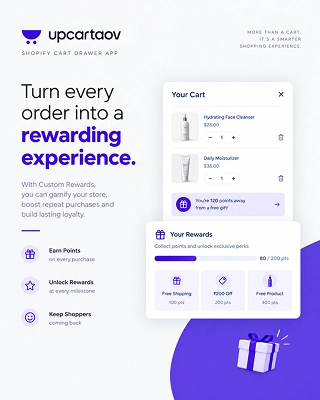
This is exactly how Frequently Bought Together bundles work. It also powers trigger-based upsell offers Shopify cart setups like:
- A free shipping bar that updates its message as the cart total climbs
- A free gift that appears automatically once a threshold is crossed
Strengths:
- Full control over what gets recommended
- No sales history required, works from day one
- Easy for anyone on your team to understand
- Fast to set up
Weaknesses:
- Doesn’t scale well past a few hundred products
- Needs manual upkeep as your catalog changes
- Can’t catch patterns a human wouldn’t think to test
Real example: Jenna’s store has about 45 products, all tightly curated. Rules were more than enough:
- She already knew which products belonged together
- She didn’t need software to tell her a cleanser buyer probably wants a toner too
- She wrote six or seven pairings in one afternoon and had them live the same day
- No developer, no waiting period, no algorithm needing weeks of order data first
That’s the real appeal of rule-based logic, it respects the fact that you, as the merchant, often already know your customers better than any algorithm could guess on day one.
AI-Based Personalization: How It Works
AI-based personalization flips the process. Instead of a person writing the rules, an algorithm studies patterns across your whole store and generates the recommendation automatically.
| Cart contents + order history + browsing data | v AI engine finds patterns | v Predicted “best fit” recommendation shown automatically, no manual rule needed |
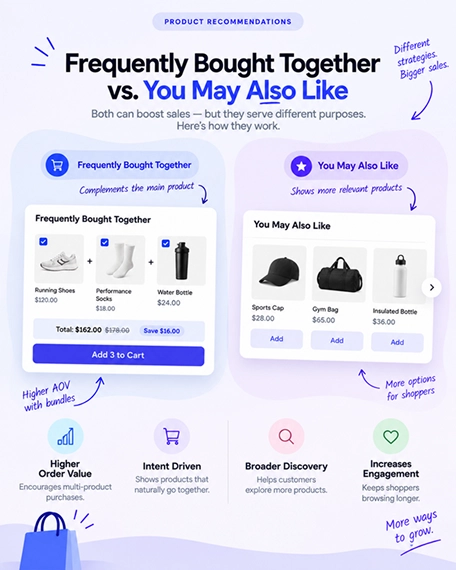
This is the logic behind most AI product recommendations for upselling systems, including the engine built into Shopify itself, which many recommendation apps tap into.
Strengths:
- Scales automatically as your catalog grows
- Surfaces pairings a human might never think to test
- Keeps working without constant manual updates
Weaknesses:
- New stores face a “cold start” problem, no data yet to learn from
- Feels like a black box; you don’t always know why it picked something
- Less merchandising control for you as the brand owner
Neither method wins in every situation. It comes down to three things:
- Catalog size: small vs. large
- Data history: new store vs. established
- Control: how much say you want in what gets shown
A 3,000-SKU marketplace-style store has a very different problem than a 40-product boutique brand. The right method should match that difference, not whichever option sounds more impressive.
Rule-Based vs AI: Side-by-Side Comparison
| Factor | Rule-Based | AI-Based |
| Setup time | Fast — minutes per rule | Slower — needs data to “learn” |
| Control over recommendations | Full control | Partial, algorithm-driven |
| Best catalog size | Small to medium (under ~300 SKUs) | Large, high-SKU-count stores |
| Data required | None | Needs order/browsing history |
| Scalability | Manual upkeep as catalog grows | Scales automatically |
| Transparency | Easy to explain | Often a “black box” |
Use this table as a gut-check before choosing how you’ll personalize upsells based on cart contents for your own store.
Which Approach Fits Your Store? (Decision Framework)
| Your Situation | Recommended Approach |
| New store, little to no sales history | Rule-based to start |
| Small, curated catalog (under 300 products) | Rule-based |
| Large catalog, high traffic, lots of order history | AI-based or hybrid |
| Tight brand story where every pairing matters | Rule-based |
| Fast-growing store adding new SKUs weekly | AI-based or hybrid |
Marlowe & Wren fell into rows two and four, small catalog, strong opinions about what belongs together. A bigger multi-category brand with thousands of SKUs would spend forever writing manual rules for every pairing. That’s a far better fit for AI.
The Hybrid Approach: Combining Rules + AI
Most guides frame this as an either-or choice. It isn’t. Plenty of stores run both at once.
| Cart Contents / \ Bestseller? Everything else | | v v Manual Rule AI / Collection Engine | | v v Fixed bundle shown Dynamic pick shown |
This is one of the smartest cart-based upsell personalization strategies available, because it solves the weak spot of each method:
- Rules alone don’t scale
- AI alone struggles without data
- Combined → tight control where it matters most, automatic coverage everywhere else
In practice, this usually looks like:
- Manual bundles for your top 10–20 bestsellers
- AI or collection-based recommendations for the rest of the catalog
- A rule-based free shipping bar or gift trigger layered on top of both
Real Examples: Cart-Content Personalization in Action
| Cart Trigger | What Happens | Type |
| Cart reaches $75 | A free gift is automatically added at $0.00 | Rule-based |
| Cart is $12 short of free shipping | Progress bar updates: “Add $12 more for free shipping” | Rule-based |
| Customer adds a bestseller | “Frequently Bought Together” bundle appears with an “Add all to cart” button | Rule-based |
| Customer views a product page | “You May Also Like” shows 4 related items based on collection or engine logic | AI/collection-based |
This is a complementary product upsell by cart items done right; each trigger reacts to something the shopper just did, instead of showing an unrelated, generic suggestion.
How to Set This Up on Shopify (No-Code Walkthrough)
Here’s exactly how Jenna set this up using UpCartAOV’s cart drawer blocks. No developer, no theme code.
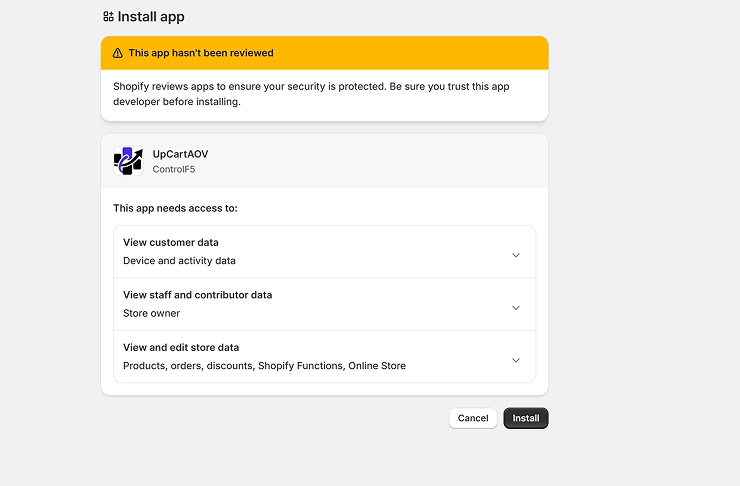
Step 1: Install the app and open your dashboard.
Go to the Shopify App Store → add UpCartAOV → open it from your Shopify Admin under Apps.
Step 2: Turn on Frequently Bought Together.
Go to Blocks → Frequently Bought Together → Add Rule. Pick a bestseller from the dropdown, select 1–2 complementary products to pair with it, then click Save.
Step 3: Set up your Free Shipping & Discount Bar.
Go to Blocks → Free Shipping & Discount Bar → Toggle On. Set your spend threshold slightly above your current average order value.
Step 4: Turn on Free Gift with Purchase (optional).
Go to Blocks → Free Gift with Purchase → Toggle On. Choose your spend threshold and select which product gets added automatically.
Step 5: Enable You May Also Like for the rest of your catalog.
Go to Blocks → You May Also Like → Toggle On. Choose your recommendation source — same collection or Shopify’s built-in engine.
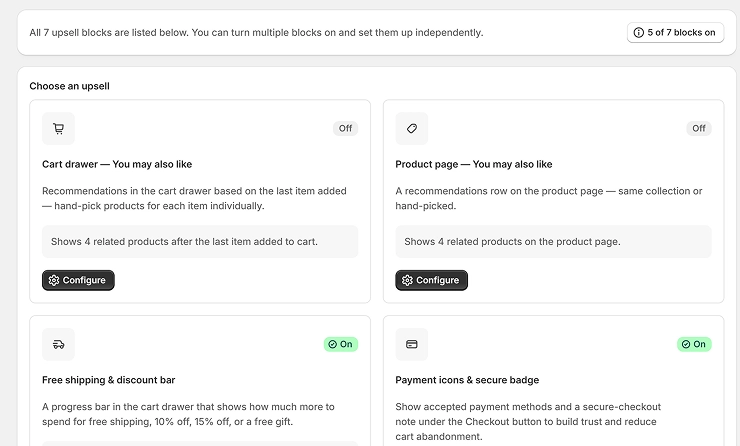
Step 6: Preview before publishing.
Use the live storefront preview inside the dashboard to check the cart drawer before it goes live.
Step 7: Publish and monitor.
Turn the blocks on for your live store. Check Dashboard → Reports after two weeks to see which bundles and triggers are converting.
Step 8: Adjust monthly.
Swap out any bundle or rule that isn’t performing. Rules aren’t set-and-forget; a quick monthly review keeps them relevant as your catalog changes.
Conclusion
Jenna didn’t pick a side. She used manual bundles for her bestsellers, a free shipping bar, and a free gift trigger, three rule-based blocks working together. Within a few weeks, her average order value moved for the first time in almost a year.
Whether you lean rule-based, AI-based, or a mix of both, the goal stays the same:
- Stop showing generic recommendations
- Start reacting to what’s actually sitting in the cart
It doesn’t take a big redesign or a data science team to get started, just a handful of well-thought-out rules, tested and adjusted over time.
UpCartAOV’s cart drawer blocks, Frequently Bought Together, the free shipping bar, and free gift rewards are built to handle exactly this kind of dynamic cart rules for ecommerce upsells, with no code required.
If a boutique brand like Marlowe & Wren can move its average order value in a few weeks with a handful of simple rules, there’s a good chance your store can too.
FAQ
Question: Is AI upselling better than rule-based for small stores?
Answer: Not usually. Small stores with limited order history typically get faster, more reliable results from simple rule-based bundles. AI needs data to learn from, and a small catalog doesn’t always provide enough.
Question: Does personalization slow down my store’s page speed?
Answer: It shouldn’t, as long as the app loads asynchronously. Look for cart drawer apps built as lightweight extensions rather than ones adding render-blocking scripts.
Question: Can I combine both rule-based and AI approaches in one store?
Answer: Yes, many successful stores do. Manual rules for your best-converting bundles, paired with broader AI or collection-based recommendations for everything else, is one of the most practical ways to run AI vs manual merchandising for cart upsells without constant manual work.
Question: How many rules should I start with if I’m new to this?
Answer: Start small. Five to ten rules covering your bestsellers is usually enough to see a real lift in average order value. You can always add more once you see which pairings are converting.

