
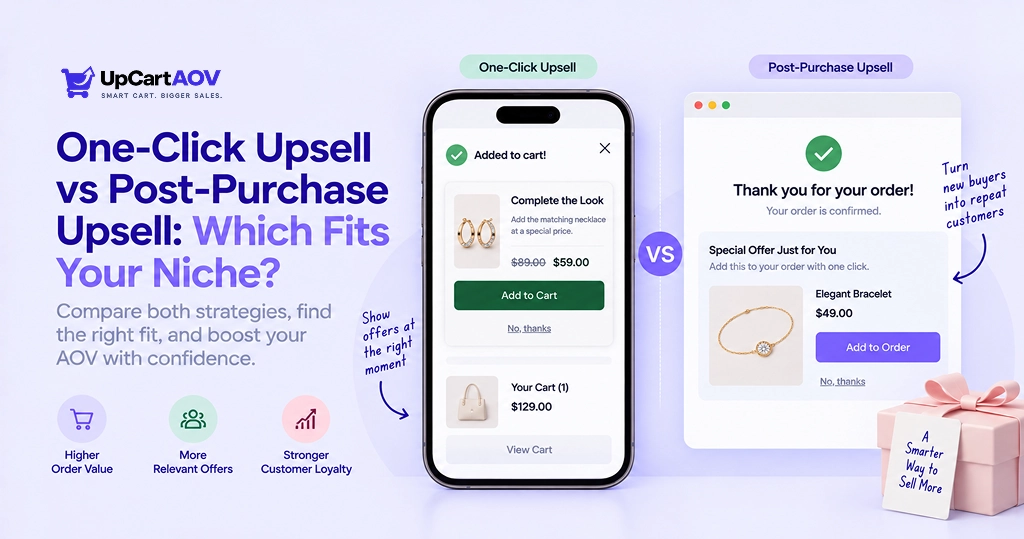
It was almost midnight when a merchant messaged me, half-panicked. His store was pulling decent traffic, ads were converting fine, but his average order value hadn’t moved in six months. He’d just installed a post-purchase upsell app that week because “everyone’s doing it in 2026,” and yet, nothing changed.
I asked him one simple question: “Where does your customer actually decide to buy more, before they pay, or right after?”
Silence. He genuinely didn’t know.
That’s the real story hiding behind one-click upsell vs post-purchase upsell. It isn’t a fight between two technologies where one wins and one loses. It’s about timing, about catching your customer at the exact moment they’re emotionally ready to say “yes” one more time.
I’ve spent over 14+ years building, fixing, and advising Shopify stores at ControlF5. In that time, I’ve watched dozens of founders install the wrong upsell type simply because a case study or a YouTube video told them to.
So before you spend another rupee or dollar on an app, let’s slow down and figure out which upsell fits your niche ecommerce business, not someone else’s.
By the end of this blog, you’ll know exactly where your customer’s buying window opens, and how to place your offer right inside it.
One-Click Upsell vs Post-Purchase Upsell
What Is a One-Click Upsell? (Definition + How It Works)
A one-click upsell happens before the sale is locked in, on the product page, inside the cart drawer, or right before checkout begins.
The customer sees something relevant (“Add this leather belt for $19.99?”) and taps once to add it. No re-typing card details. No leaving the page. No breaking momentum.
Picture a barista who asks, “Want to make that a large?” while you’re standing at the counter, wallet already out, card already in hand. That’s a one-click upsell in spirit, low friction, high intent, instant decision.
This is exactly the moment tools like UpCartAOV are built for. A “You May Also Like” carousel on the product page, a free shipping progress bar, a gift-with-purchase threshold inside the cart drawer, all designed to catch that “still deciding, still holding my wallet open” window before it closes.
Flowchart — the one-click path:
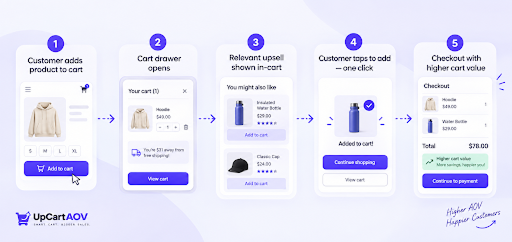
Simple, right? The whole idea is: don’t make them think twice, make it effortless to say yes while they’re already leaning in.
What Is a Post-Purchase Upsell? (Definition + How It Works)
A post-purchase upsell shows up after the customer has already paid, usually on the thank-you page, sometimes in a follow-up email a few minutes later.
Here’s the clever part: it relies on payment tokenization for one-click add-ons. In plain English, that means the store securely reuses the card details the customer already entered, so they can add another item without typing anything twice. Smooth in theory, but it only works if your checkout platform supports it, like Shopify Plus checkout extensibility or specific WooCommerce plugins.
It’s the “would you like fries with that, we’ll just add it to what you already paid for” moment. Except here’s the catch: the customer’s wallet is already closed. Mentally, they’ve moved on. You’re asking them to reopen a door they just shut.
Flowchart: the post-purchase path:
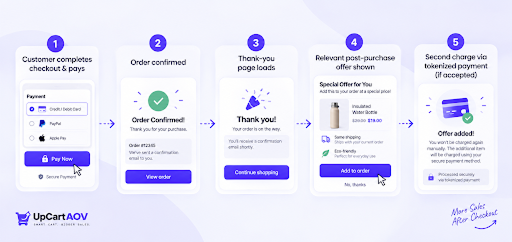
Neither flow is “wrong.” They’re just built for two very different emotional states, one while the customer is still deciding, one after they’ve already committed.
My Experience: What 4,000+ Shopify Projects Taught Me About Timing
Let me be honest with you, founder to founder, because this is the part most blogs skip.
Across the 4,000+ Upwork projects and 150+ Clutch-verified engagements my team at ControlF5 has delivered, one pattern shows up again and again: the upsell that wins isn’t the trendiest one; it’s the one that matches how your specific customer shops.
Fashion, beauty, and accessory brands with fast, impulse-driven carts?
One-click upsells inside the cart drawer consistently outperform anything shown after checkout. Why? Because the customer is still “in the moment”, still emotionally warm, still holding their card.
High-consideration purchases behave completely differently. Furniture, electronics, anything crossing the $200–300 mark- customers there often want breathing room right after paying, not another decision shoved in their face mid-checkout.
That’s exactly where post-purchase upsell strategies increase AOV without threatening the sale that matters most: the first one.
This isn’t a theory I read somewhere. It’s what happens when you’ve sat inside enough merchant dashboards, watched enough heatmaps, and seen enough drop-off points with your own eyes to know the difference between a “smart offer” and an “annoying interruption.”
Trust Signals: Why Timing Data Actually Matters (Not Just Opinions)
Here’s something I tell every merchant who’s tempted to copy a competitor’s setup: don’t trust a strategy just because it worked for someone else’s store. Trust the data your own customers give you.
That said, industry-wide patterns are still useful as a starting compass.
Here’s roughly where upsell take rate benchmarks in ecommerce data tend to land, based on patterns across the stores I’ve personally worked with:
| Upsell Type | Typical Take Rate | Typical AOV Lift | Best Suited For |
|---|---|---|---|
| One-click (cart drawer) | 8–15% | 10–20% | Impulse, low-to-mid AOV niches |
| Post-purchase (thank-you page) | 3–8% | 5–15% | High-consideration, high-ticket niches |
| Combined / hybrid approach | 12–20% | 15–30% | Subscription & replenishment niches |
And here’s the side-by-side comparison I sketch on an actual whiteboard for every founder who asks me this question over a call:
| Factor | One-Click Upsell | Post-Purchase Upsell |
|---|---|---|
| Timing | Before checkout completes | After payment is confirmed |
| Risk to original sale | Low — offer is optional, doesn’t block checkout | Zero — original sale is already locked in |
| Technical dependency | Cart drawer/theme app blocks | Payment tokenization; needs checkout extensibility |
| Best for | Low-to-mid AOV, impulse niches | High-consideration, higher-ticket niches |
| Customer friction | Minimal — same session, same momentum | Can feel like “one more ask” if overused |
| Setup complexity | No-code, fast (apps like UpCartAOV) | Often requires Plus-tier checkout or specialized apps |
Numbers like these are directional, not gospel. Your niche, price point, and traffic quality will shift them. But they give you a sane starting point instead of a blind guess.
Which Fits Your Niche? Breaking It Down by Business Type
This is the section I genuinely wish every founder read before installing any app.
1. Low-AOV, impulse niches (apparel, accessories, beauty):
Your customer decides fast, sometimes in seconds. A one-click upsell funnel Shopify WooCommerce stores can build in minutes, right inside the cart drawer, catches that impulse before it fades.
Niche-specific upsell offers here work best as accessories or complementary add-ons: a scarf next to a coat, a phone case next to a phone.
2. High-consideration, high-ticket niches (furniture, electronics, appliances):
Customers need to feel the first decision is safely done before you ask for a second one. Post-purchase upsells, extended warranties, protection plans, accessory bundles, fit naturally here because they don’t threaten the primary purchase mid-checkout.
3. Subscription and replenishment niches (skincare, supplements, coffee, pet food):
This is where niche-specific upsell offers like refills genuinely shine, and honestly, a hybrid model tends to win. A one-click “add a refill” inside the cart, paired with a post-purchase “subscribe and save 15%” offer, covers both the impulse buyer and the planner in the same funnel.
A quick decision flow to find your fit:
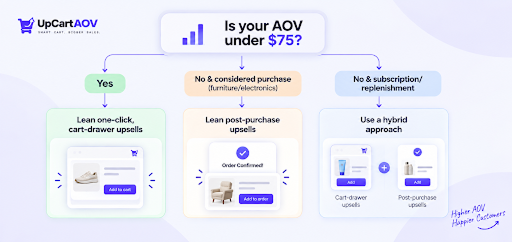
If you’re still unsure after this, that uncertainty itself is useful data; it usually means your customers are mixed, and a hybrid test is worth running before committing to one path.
Authoritativeness Check: What the Industry Gets Wrong About “Best Practices”
A lot of blogs will tell you post-purchase upsells are the “advanced” move and one-click is the “beginner” move. I want to push back on that gently.
Sophistication isn’t the goal. Fit is.
I’ve seen six-figure-a-month fashion stores stick with a simple cart-drawer upsell because it’s what their impulse-driven customer base responds to, and outperform competitors running complex post-purchase funnels.
I’ve also seen a furniture brand try a one-click cart upsell and watch it flop, because nobody wants to be sold a second sofa cushion while they’re still deciding on the sofa itself.
The lesson: authority in ecommerce doesn’t come from using the newest checkout tech. It comes from understanding your customer’s psychology at each stage of the funnel, and having the humility to test rather than assume.
Common Mistakes Merchants Make With Upsell Timing
I’ve watched these three mistakes quietly drain revenue from otherwise healthy stores:
- Stacking too many one-click offers pre-checkout. This increases cart abandonment instead of boosting AOV. One relevant offer beats five random ones every time.
- Assuming post-purchase upsells are “free money.” They’re not. A poorly targeted thank-you page offer just gets ignored, wasting a valuable placement.
- Never testing both. Most merchants pick one path and never run a side-by-side comparison. Remember the founder from our opening story? He hadn’t tested a single alternative before switching entirely to post-purchase, and paid for that assumption in stalled AOV.
A smaller, sneakier mistake worth naming too: copying a competitor’s upsell copy word-for-word.
What sounds persuasive on a beauty brand’s cart drawer can sound tone-deaf on a hardware store’s thank-you page. Match the tone to your niche, not just the mechanism.
How to Implement Either Strategy Without Custom Code
Here’s the good news: you genuinely don’t need a developer for either approach anymore.
For one-click upsells, tools like UpCartAOV plug directly into your Shopify cart drawer — a free shipping bar, a gift-with-purchase threshold, a “You May Also Like” carousel — all configured through simple toggles, live in under two minutes, with zero lines of theme code touched.
For thank-you page upsell best practices 2026, the current standard looks like this:
- Show only one offer, not three or four
- Make it visually distinct from the checkout flow so it doesn’t feel like a hidden charge
- Price it well below the original purchase so it reads as a bonus, not a second ask
- Use payment tokenization for one-click add-ons so there’s zero re-entry of card details
My honest, no-fluff advice as someone who’s set this up hundreds of times: start with one-click, cart-drawer-first. It’s lower risk, faster to launch, and gives you real behavioral data before you invest time and money into post-purchase infrastructure.
A Simple Framework You Can Actually Use This Week
If all of this still feels like a lot, here’s the shortcut version I give founders on calls:
- Pull your last 90 days of order data. What’s your average order value, and how fast do customers typically decide (impulse vs. research-heavy)?
- If your AOV is under $75 and purchases feel impulsive, start with a cart-drawer one-click upsell.
- If your AOV is high and purchases feel considered, test a single, well-priced post-purchase offer.
- If you sell anything consumable or subscription-based, run both: refill nudges in-cart, subscription offers post-purchase.
- Give whichever you choose 2–3 weeks of real traffic before judging it. One week of data is noise, not insight.
This isn’t complicated. It’s just disciplined.
Conclusion: Match the Upsell to the Moment, Not the Trend
If 14+ years in Shopify ecommerce has taught me one thing, it’s this: the debate over one-click upsell vs post-purchase upsell isn’t really a debate at all. It’s a diagnosis.
Look at how your customer shops. Look at how considered their purchase is. Look at how much friction your checkout can realistically absorb without pushing them away. Once you look honestly at those three things, the answer to which upsell fits your niche ecommerce business stops feeling like guesswork.
For most founders just starting this experiment, the cart drawer remains the easiest, lowest-risk place to begin.
If you want to see what that actually looks like without touching a single line of code, UpCartAOV sets up a free shipping bar, gift rewards, and a smart upsell carousel in under two minutes, built specifically so you can test this for yourself instead of guessing at midnight, as our founder from the opening story did.
Test it. Watch your own numbers. Let your customers tell you which upsell fits, not a blog, not a competitor, and not a trend cycle.
FAQs
Question: Is one-click upsell better than post-purchase upsell? 4
Answer: Neither is universally better; it depends on your niche, price point, and how fast your customer decides. Impulse niches favor one-click; considered purchases favor post-purchase.
Question: Can I use both on the same Shopify store?
Answer: Yes, and for many niches, especially subscription or replenishment brands, a hybrid approach tends to outperform either one alone.
Question: Does post-purchase upsell require checkout extensibility or Shopify Plus?
Answer: Often yes, since it relies on payment tokenization for one-click add-ons, which needs deeper checkout access than most base-tier plans allow.
Question: Which upsell type has better ROI for small stores?
Answer: For most small and mid-sized stores, one-click cart-drawer upsells tend to have a faster setup-to-ROI timeline, since they don’t require checkout-level integration.
Question: What’s a realistic upsell take rate to expect in my first month?
Answer: Based on typical upsell take rate benchmarks from ecommerce data, expect somewhere between 5–12% in your first month, with room to improve as you refine offer relevance and placement.

