
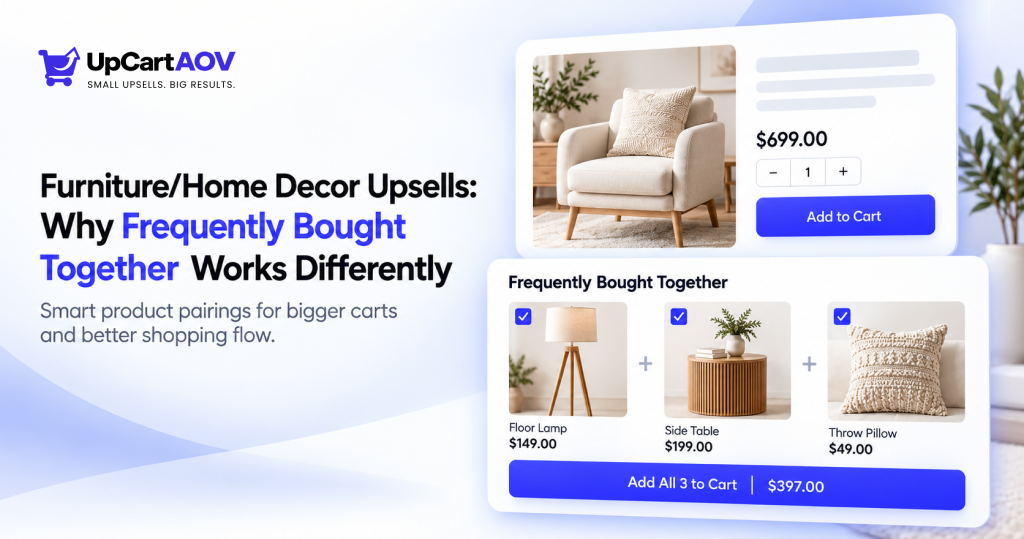
My team and I were going through a furniture store’s Shopify setup when something on a product page made us all stop scrolling.
A beautiful $1,400 oak dining table. And right below it, a “Frequently Bought Together” block showing… another dining table and a bookshelf.
Nobody buys two dining tables in one go.
That small moment explains why frequently bought together furniture needs a completely different playbook.
I’ve spent years building and fixing Shopify stores, and home and lifestyle brands always teach me something new. The logic that works for a t-shirt store or a skincare brand simply doesn’t carry over to sofas, beds, and wall art.
So in this blog, I’ll walk you through what my team and I have learned. Why furniture buyers think differently, where generic FBT breaks, and the furniture upsell strategies that actually work.
Why Furniture Buyers Behave Differently from Typical Ecommerce Shoppers
Think about the last time you bought a sofa.
You probably didn’t buy it on your first visit. You measured the room. You checked the colour against your curtains. You may have sent a screenshot to your partner and asked, “What do you think?” Then you came back three or four times before clicking “Buy.”
That’s the furniture buyer. Here’s how I see the difference:
- High-ticket → one big decision, lots of doubt
- Low frequency → most people buy a sofa or a bed once every few years
- Room-based thinking → “How will my living room look with this?”
- Real-life constraints → space, delivery dates, assembly, narrow stairs
A skincare buyer thinks, “What else goes with this serum?” A furniture buyer thinks, “What does this room still need?”
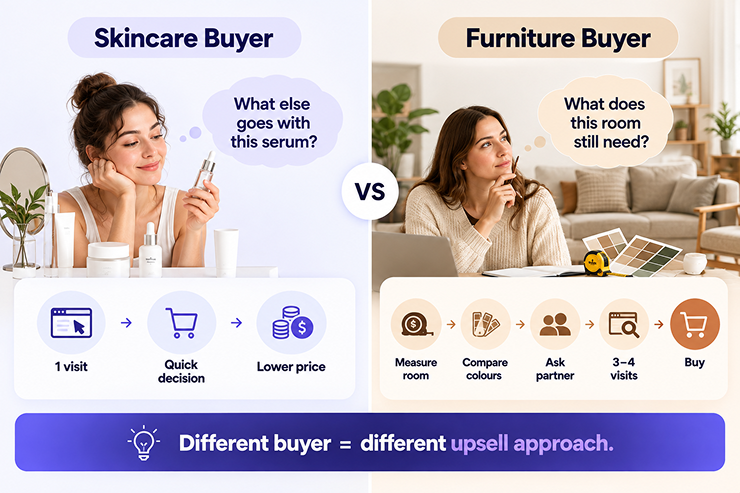
That one shift changes everything about home decor cross-selling. And honestly, I think most upsell setups miss it.
Where Generic “Frequently Bought Together” Falls Short
Let’s go back to that dining table.
The Shopify store’s upsell tool was doing exactly what it was built to do. It looked at order history and showed products that appeared together.
The problem? The Shopify furniture store didn’t have enough orders for that data to mean anything.
That’s the first crack. Big-ticket stores don’t have the order volume of a fashion or beauty brand. A default frequently bought together Shopify setup depends on that data, so it ends up guessing.
And the guesses show:
- Wrong product type → another sofa, when the buyer actually needs a cushion
- Price mismatch → a $900 rug next to a $1,100 sofa feels like a second big purchase, not an add-on
- Style clash → an industrial metal lamp next to a boho rattan chair
That last one hurts the most. The shopper thinks, “This Shopify store doesn’t get my taste.” And trust drops.
In furniture, a bad recommendation doesn’t just get ignored. It makes the buyer question the whole store.
Choosing the right recommendation format can help furniture stores suggest products that complement a shopper’s main purchase. Learn more about Frequently Bought Together vs. You May Also Like to understand which approach works best for different product types and shopping behaviours.
A Quick Look at the Numbers
Before going further, here are two numbers my team often talks about:
| Market Insight | What It Means for Furniture Stores | Source |
| The global home decor market was valued at USD 960.14 billion in 2024 and is projected to reach USD 1,622.90 billion by 2030 (9.4% CAGR) | More buyers are decorating and upgrading homes → more room for smart add-ons | Grand View Research |
| The United States was the biggest furniture e-commerce market in 2025, with estimated revenue of USD 120.93 billion | Online furniture shopping is huge, and so is the opportunity per order | Statista |
Here’s how I read these numbers. Money is moving online → buyers are spending big on furniture → decor sits right next to it. That’s a perfect setup for upsells. But only if the recommendations actually make sense for the room.
So the goal isn’t more recommendations. It’s the right ones.
What Actually Works: FBT Strategies for Furniture and Home Decor
After working with many home and lifestyle stores, this is where my team’s thinking landed.
“Complete the Look” and Room-Based Bundles
Stop thinking in products. Start thinking in rooms.
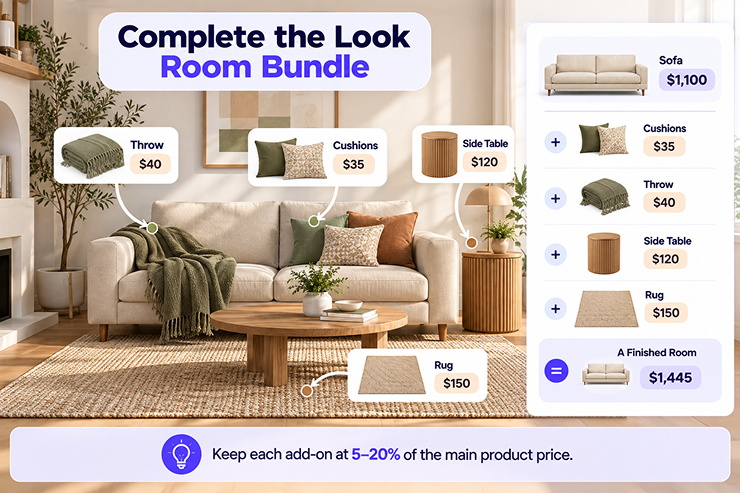
A complete the look upsell shows the sofa together with the cushions, throw, side table, and rug that made the product photo look so good. The shopper already fell in love with that styled image. You’re simply letting them take the whole feeling home.
Example: A shopper lands on a grey 3-seater sofa. Instead of showing random bestsellers, the page shows the exact styling from the product photo: two mustard cushions, a knitted throw, and a round wooden side table. One click → the whole corner goes to the cart. The shopper isn’t buying “extra products.” They’re buying the room they already imagined.
Functional Add-ons
These are the quiet winners. Fabric protector, felt pads, wood care kits, extra hardware, assembly service.
Low price + real usefulness = almost zero hesitation.
Example: Someone adds a $1,200 fabric sofa to the cart. The cart drawer shows a $29 fabric protector spray with a simple line: “Keeps spills and stains off your new sofa.” Nobody wants a coffee stain on day three. It’s a small price for peace of mind, so it’s an easy yes.
Style-Matched Decor Pairings
Match by material, colour, and vibe. Not by “most popular items.”
Walnut table + brass lamp + earthy ceramic vase → feels curated. Walnut table + neon LED sign → feels random.
Example: A buyer is looking at a rattan accent chair. The recommendations show a jute rug, a cane-textured lamp, and a macramé wall hanging, all in the same boho mood. Now compare that with showing a glossy black metal lamp. Same price, completely different feeling. One says “this store gets my style,” the other says “this store is guessing.”
Tiered Pricing Logic
Here’s a simple rule my team follows: keep the add-on at roughly 5–20% of the main product’s price.
Main item at $1,000 → add-ons between $50 and $200 feel easy. Go higher, and it starts feeling like a second purchase decision.
Example: A $900 queen bed frame. Good add-ons → $60 mattress protector, $45 pillow set, $120 bedside lamp. All between 5% and 15% of the bed price. Now imagine suggesting a $700 wardrobe instead. The buyer stops, rethinks the budget, and might leave with nothing. Small add-on = small decision. Big add-on = second big decision.
Bundle with Services
White-glove delivery, assembly, old furniture removal. In my experience, these often convert better than products, because they remove a real worry from the buyer’s mind.
Example: A customer buying a 6-seater dining table sees an option: “Add doorstep assembly for $49.” The table is heavy, the instructions look confusing, and the weekend is already busy. That $49 solves a real problem, and it often gets picked faster than any decor item.
Here’s how some of these bundles can look in practice:
| Room Setup | Main Product | Smart Add-ons | Why It Works |
| Bedroom | Queen bed frame | Mattress protector + bedside lamp + throw pillows | Completes the room, and add-ons feel small next to the bed |
| Living room corner | Accent chair | Side table + floor lamp + throw blanket | Recreates the styled product photo |
| Dining setup | Dining table | Table runner + chair pads + wood care kit | Mixes practical care with decor |
This is how product bundles for home decor should feel. Like a finished room, not a pile of random extras.
Placement Matters: Where to Show FBT Offers in a Furniture Store
I always tell Shopify merchants: where you show an offer matters as much as what you offer.
- Product page → best for the complete-the-look upsell, because the buyer is still imagining the room
- Cart drawer → best for low-ticket decor add-ons. The big decision is already made, so a $35 cushion is an easy “yes”
- Post-purchase → great for care kits, protection plans, and matching pieces
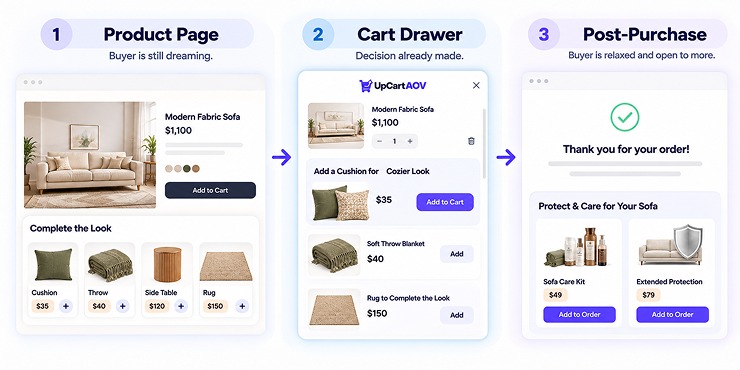
Why do small add-ons convert better in the cart? Because the stress is gone. The buyer has already said yes to the sofa. Now they’re in a relaxed, “let me finish this” mood.
One more thing on mobile. Furniture images are big and detailed. Squeezing six recommendations under them on a small screen = clutter. We usually keep it to 2–3 options.
Too many recommendations, crowded layouts, and poorly placed offers can distract shoppers instead of helping them. Avoid these cart drawer UX mistakes that cost Shopify stores sales when designing a furniture store’s cart experience, especially on mobile.
Real Examples from Furniture and Decor Stores
A solid wood furniture merchant came to us with a common complaint: “My upsell app is live, but nobody clicks on it.”
When we checked, the recommendations were fully automated. Beds were showing next to bookshelves. Dining chairs were showing next to wardrobes. Nothing felt connected.
So my team did three simple things:
- Replaced algorithm picks with room-based bundles for the top-selling products
- Moved small decor add-ons (cushions, runners, care kits) into the cart drawer
- Removed any add-on priced above 20% of the main item
The result? More orders started including at least one add-on, and the store owner told us the recommendations finally “looked like the store.”
We’ve also seen mistakes. One Shopify merchant bundled a rug that was out of stock for three weeks.
The whole order got delayed, and the customer was upset about a $1,200 sofa because of an $80 rug. Lesson learned → always check stock and delivery timelines before bundling.
Manual Curation vs AI Recommendations: Which Is Better for Furniture?
My team believes this isn’t an either-or question.
Manual curation works better when:
- Your catalog is small or medium-sized
- Your brand has a strong, specific style
- You don’t have much order history yet
AI recommendations make sense when:
- You sell a large decor catalog with hundreds of small items
- You have enough order data for patterns to be real
If your Shopify store fits these points, take a look at these best AI recommendation apps for Shopify to find one that can handle a large decor catalog without losing your style
The hybrid approach is what I usually suggest to growing Shopify stores. Curate your hero products by hand, and let automation handle the long tail.
I strongly believe that cross-sell recommendations for high-ticket products need a human eye first. Algorithms can support that, but they shouldn’t replace your taste.
Personalized recommendations can help furniture stores suggest add-ons that match the main product, room style, and customer needs. Learn how to personalize upsells based on cart contents using product rules and AI to make recommendations more relevant.
How to Measure If Your FBT Strategy Is Working
Numbers keep us honest. Here’s what we track for home stores:
| Metric | What It Tells You | Healthy Sign |
| Average Order Value (AOV) | Are customers spending more per order? | Steady upward trend |
| Attach rate | % of orders with at least one add-on | Rising month over month |
| Add-on conversion rate | How many people accept a recommendation | Improving after changes |
| Return rate | Are bundled items coming back? | Stable or dropping |
| Checkout completion | Are upsells slowing buyers down? | Not dropping |
If you want to increase average order value for furniture store results, don’t guess. A/B test your bundles. Try “cushion + throw” against “cushion + lamp” and let real buyers decide.
And if checkout completion drops after adding upsells → too many offers. Pull back.
Furniture stores can increase order value by pairing main products with relevant add-ons, offering useful bundles, and testing different combinations. Explore these ways to increase average order value on Shopify for more ideas to encourage customers to spend more per order.
Setting Up FBT and Cart Upsells on Shopify
Shopify gives you a starting point. With the free Search & Discovery Shopify app, you can manually set complementary products, and many themes can display them on the product page.
But there are limits:
- Limited control over placement and design
- Display depends heavily on your theme
- Cart drawer upsells usually need extra tools
This is exactly the gap my team kept running into with our own clients. That’s why we built UpCartAOV, a Shopify app made for cart drawer and product page upsells. So when Shopify merchants ask me what to use, this is what I’d look for, and it’s what we built UpCartAOV around:
- Control over which products get recommended → you pick the cushion that matches the sofa, not an algorithm
- Cart drawer and product page placements → “Complete the Look” on the product page, small decor add-ons in the cart
- Clean, mobile-friendly design → recommendations that don’t crowd your big furniture images
- Easy tracking → so you can see which add-ons actually get picked
Quick setup checklist with UpCartAOV:
- Install UpCartAOV from the Shopify App Store
- Pick your top 5–10 hero products → build room-based bundles for them
- Add 2–3 low-ticket add-ons to the cart drawer
- Check stock and delivery times of every bundled item
- Track AOV and attach rate for at least a few weeks
- Adjust → test → repeat
How UpCartAOV Helps Furniture and Home Decor Stores Increase AOV
Honestly, stories like that dining table are the reason we built UpCartAOV.
As a Shopify agency, my team at ControlF5 kept seeing the same problem again and again.
Shopify merchants had great products, but their upsells felt random, cluttered, or completely off-brand. So we built a Shopify app to solve that real problem for real merchants.
Here’s how UpCartAOV fits into everything we discussed:
- Cart drawer upsells → show low-ticket decor add-ons like cushions, throws, lamps, and care kits right when the buyer is most relaxed
- Product page recommendations → build “Complete the Look” pairings that match the room, not just the order data
- Your taste, your control → choose what gets recommended so every suggestion feels like part of your store
- Clean, mobile-friendly design → recommendations that sit neatly next to large furniture images without cluttering the page
We believe furniture ecommerce upsells should feel like helpful styling advice, not a pushy sales trick. That’s the thinking behind every feature we add.
If you want smarter furniture upsell strategies and furniture ecommerce upsells that actually match how your buyers shop, and you’re ready to increase average order value furniture store numbers the right way, give UpCartAOV a try.
Right product + right moment + right price = an easy “yes” from your customer.
FAQs
Question: Does “frequently bought together” work for high-ticket furniture?
Answer: Yes, but only when it’s curated. Frequently bought together furniture works best with room-based pairings and small add-ons, not with random data-driven picks.
Question: Should furniture stores offer bundle discounts?
Answer: Small discounts can help for full-room bundles. For low-ticket add-ons, convenience usually works better than a discount.
Question: Which products are best for home decor cross-selling?
Answer: Cushions, throws, rugs, lamps, vases, care kits, and protection products. Basically, anything that “finishes” the room.
Question: Can FBT increase returns in furniture stores?
Answer: It can, if items clash in style or get delayed. Curated, in-stock recommendations keep returns under control.

